Insurance agent duty to advise: what you owe clients, and how to document it
What an insurance agent’s duty to advise covers, why the paper trail decides most E&O claims, and how to document coverage advice without late nights.

An insurance agent’s duty to advise depends on the state and on the relationship, but one thing doesn’t: when a claim goes wrong, your file is your defense. The baseline duty is to procure the coverage the client asked for with reasonable care. The moment you start recommending, you take on more, and you need to prove what you said. Here is what the duty covers, what agencies get wrong, and which part of the paperwork AI can take off your desk.
What the duty actually covers
The baseline: reasonable care in procuring coverage
In a majority of states, courts hold that an agent owes clients a duty of reasonable care and diligence in placing the coverage they request. Absent something more, that duty does not include an affirmative obligation to assess the client’s risks or recommend coverage types and limits (IRMI).
The “special relationship” that raises the bar
Courts make an exception when they find a special relationship: a long history of advising the client, the agent holding themselves out as a coverage expert, or the client clearly relying on the agent’s judgment. Whether that relationship exists is a question of fact, decided after the loss, with your file on the table.
That’s why the exception matters to every agency, not just the big ones. A producer who says “I’ll take care of everything” on a renewal call may be creating that relationship without knowing it. And E&O claims alleging that an agent should have advised on coverage the client didn’t have are a trend agencies are watching (Insurance Journal).
Annuities: a written best-interest standard
On the life side, the duty is already written into regulation. The NAIC’s 2020 revision of the Suitability in Annuity Transactions Model Regulation replaced suitability with a best-interest standard built on four obligations: care, disclosure, conflict of interest and documentation. The NAIC reports that 49 jurisdictions have implemented it (NAIC). Documentation isn’t a best practice there. It’s one of the four pillars.
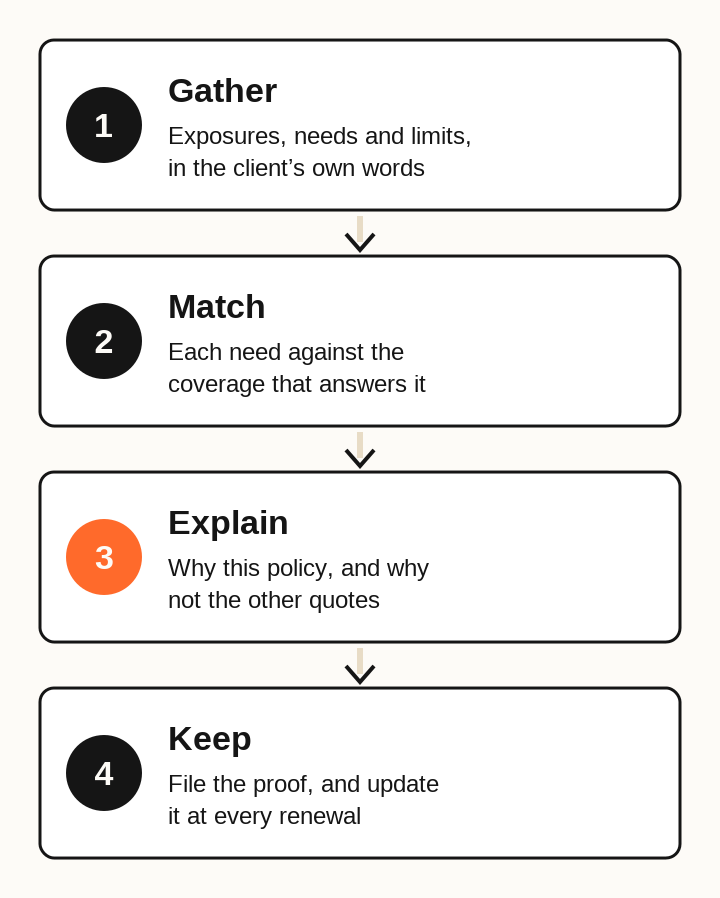
What it looks like in a real file
Take a fictional example. A 12-employee window and door installer asks for a business owner’s policy. On the call, the owner says three things: a fire in the shop would stop the business for three months, general contractors require a certificate of insurance before every job, and he can’t absorb a large deductible.
A solid advice file captures those three points, in his words, and ties each one to a coverage:
| What the client said | The coverage that answers it | Why we recommended it |
|---|---|---|
| “A fire in the shop means three months without work” | Business income, 12-month period of restoration | Covers lost income during repairs, not just the building |
| “GCs want a certificate before every job” | General liability with additional insured endorsement | Required by most GC contracts; certificate issued on request |
| “I can’t take a big deductible” | Lower-deductible option | Chosen despite the higher premium, at the client’s request |
It adds the other quotes you looked at, one line each on why they weren’t chosen. And the client’s decisions: equipment breakdown, offered and declined, with the date and the reason.
That document is what protects the agency. The problem is that someone has to write it for every account, from notes taken during the call, the quote comparison and the policy forms. Every policy placed is one more file to write up, usually at the end of the day.
The mistakes that show up in E&O claims
The boilerplate note. “Reviewed coverage with insured” on every account. It proves nothing, because it names no exposure.
The need captured, never connected. The application is complete, the quotes are attached, but nothing shows which coverage answers which concern.
The declined coverage that lives only in memory. The owner turned down business income to save on premium. Three years later the shop burns. Without a written, dated declination, his refusal looks like your omission.
The file written after the fact. Notes backfilled after binding, or after the claim, are easy to spot.
The account that never gets reviewed. The client hired, opened a second location, added a service line. The file still describes the business as it was at the first renewal.
What AI can take off your desk
The advice stays with the agent: it’s your license, your judgment and your sign-off. But most of the work around advice is write-up, and that’s where AI helps.
- The needs summary. From your call notes or the call transcript, AI drafts the client’s exposures and requests, in their own words, and flags what’s missing (revenue, headcount, existing policies) or contradictory.
- Needs matched to coverage. It reads the comparison and the policy forms and fills the table: each need against the coverage that answers it, with the form reference. A need with no matching coverage stays visible. For the comparison itself, see how to go from five carrier PDFs to one spreadsheet.
- Alternatives and declinations. It writes one factual line per quote not chosen, and lists the declined coverages for the client to acknowledge, following your agency’s procedure.
- Account reviews. It prepares the renewal check-in that brings the file up to date.
The draft lands in your agency management system, in your existing templates: AI fills them, it doesn’t replace them. The account manager reviews, edits, completes and signs off. You save the writing time. The advice is still yours.
For the other agency tasks AI can handle, read what AI does, and doesn’t do, for insurance agents. And to see which ones are worth it in your agency, book a free call with Tasolia.
FAQ
Do insurance agents have a duty to advise clients on coverage?
In most states, the baseline duty is to use reasonable care in procuring the coverage the client asks for, not to advise on what they should buy. That changes when courts find a special relationship, for example when the agent holds themselves out as an expert or the client relies on them for coverage decisions. Check your state’s case law.
What should a coverage recommendation file contain?
The client’s exposures and requests in their own words, the coverage you recommended and why, the alternatives you quoted, and every coverage the client declined, with the date and the reason. If it isn’t written down, it is your word against theirs.
Should declined coverage be signed by the client?
Many agencies use a signed declination or acknowledgment form for coverages the client turns down. At minimum, document the offer and the refusal in writing, dated, in your agency management system. Your E&O carrier often has a template.
Can AI write the advice documentation for me?
It can draft it from your meeting notes, the quote comparison and the policy forms. The recommendation stays yours: you review it, complete it and sign off. AI saves the writing time, not the responsibility.
What about your agency?
A free call, no commitment, to find the 2 tasks to automate first.
Book your free call