Insurance agency compliance: the rules behind every client file, point by point
Insurance agency compliance, point by point: licensing and CE, best interest, disclosure, documentation and advertising, with the mistakes agencies repeat.

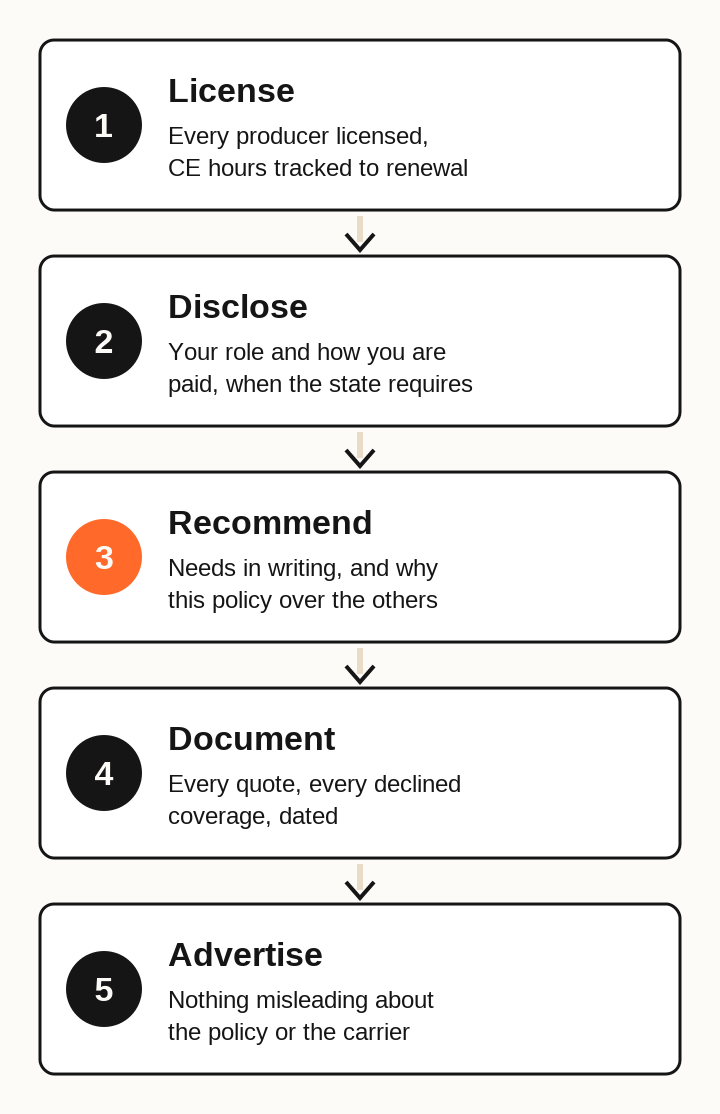
Insurance agency compliance comes down to five things you have to be able to prove for every client: that the producer was licensed, that you disclosed what the state requires, that your recommendation served the client, that it’s documented, and that nothing you said or published was misleading. None of it is new. What costs time is proving it, file by file, across every state you write in. Here is each rule, where it comes from, what it means on a Tuesday afternoon at the agency, and which part of the work AI can take off your desk.
Where the rules come from
There is no single federal rulebook. Insurance is regulated state by state, and most states build their rules from model laws written by the National Association of Insurance Commissioners (NAIC). The wording changes from state to state; the logic doesn’t.
1. Every producer is licensed, and stays licensed
The NAIC Producer Licensing Model Act (#218) starts with a simple rule: a person shall not sell, solicit or negotiate insurance in the state for a line of business without a license for that line. License renewal is tied to the continuing education (CE) requirements each state sets, and the model lets a nonresident producer meet them through their home state’s CE when the states recognize each other.
At an agency, that means a list: every producer, every line, every state, every renewal date, and the CE hours behind each one.
2. Recommendations serve the client
For annuities, the NAIC Suitability in Annuity Transactions Model Regulation (#275), revised in 2020, sets a best interest standard. A producer recommending an annuity must act in the consumer’s best interest, without putting the producer’s or the insurer’s financial interest ahead of the consumer’s. The model breaks that into four obligations: care, disclosure, conflict of interest and documentation.
Outside annuities, the duty is set mostly by each state’s case law, and it grows the moment you start recommending. We covered it in detail in what an insurance agent owes clients, and how to document it.
3. Disclose what the state requires
Disclosure rules vary more than anything else on this list. The annuity model requires producers to disclose their role and how they are paid. Some states add their own compensation disclosure rules for every line. Check your state, and keep one up-to-date disclosure template the whole team uses.
4. Nothing misleading, in any channel
The NAIC Unfair Trade Practices Act (#880) prohibits misrepresentations and false advertising of insurance policies, including any statement that misrepresents a policy’s benefits or the financial condition of an insurer, or that is made to induce a client to drop or replace a policy. Your website, your emails and your social posts are all in scope.
5. Document, or it didn’t happen
The documentation obligation is written into the annuity model. Everywhere else, it is simply how agencies win E&O claims: the file is the defense.
What it looks like at the agency
Each rule fits on one line. At the agency, each one turns into a document you need to produce, at the right moment, for each client:
| The rule | What the agency must be able to show | When |
|---|---|---|
| Licensing and CE | Active license per producer, line and state; CE certificates | Before quoting, and at every renewal |
| Best interest (annuities) | The consumer profile, the reasons for the recommendation, the alternatives considered | Before the sale |
| Disclosure | The disclosure the state requires, dated | Before the sale |
| Documentation | Needs in writing, quotes run, declined coverage with date and reason | Before binding |
| Advertising | Approved copy for the website, emails and social posts | Every time something goes out |
Take a made-up example. A four-person independent agency writes, in the same week, a BOP for a restaurant, a three-vehicle commercial auto policy and a small group health plan. Three files, three carriers, three sets of forms. For each one, someone has to confirm the producer is appointed and licensed for the line, write up the recommendation, record what the client turned down and send the right disclosures. Nothing hard. Multiplied by a year of policies, it is real work, often done after hours, and that is where the gaps show up.
The mistakes agencies repeat
CE tracked in December. Renewal is close, and one producer is short on hours, with certificates missing for the others.
The nonresident license nobody renewed. The agency still writes a few policies in a neighboring state. The license lapsed last spring.
A recommendation with no reasons. The file says the policy “meets the client’s needs” and names none of them. It proves nothing.
Declined coverage that lives only in someone’s memory. The client turned down business interruption to save premium. Three years later, the kitchen burns. Without a dated note, the refusal looks like the agency’s oversight.
Marketing copy nobody reviewed. A social post promises “the best coverage at the lowest price.” That is exactly the kind of claim unfair trade practice rules are about.
What AI can take on
Compliance stays with the agency: the recommendation, the choice of carrier and the signature belong to the licensed producer. But much of compliance work is document prep and file checks, and that is where AI helps.
- Checking the file before it goes out. AI confirms that the needs, the recommendation, the quotes, the declinations and the required disclosures are all in the file, and flags what is missing before binding.
- Drafting the recommendation. From your meeting notes, the quote comparison and the policy forms, it drafts the write-up, need by need. For the comparison itself, see how to go from five carrier PDFs to one spreadsheet.
- Tracking licenses and CE. It keeps the list of producers, lines, states and renewal dates, and warns well before a license or a CE deadline is missed.
- Reviewing marketing copy. It flags absolute claims and comparisons before a post or an email goes out, for a human to decide.
All of this sits alongside your agency management system, not instead of it: documents stay in the client file, where your team already looks for them. To see the other agency tasks AI can take over, read insurance agency automation, task by task. And to find out which ones are worth it at your agency, start here.
FAQ
Is there one federal rulebook for insurance agencies?
No. Insurance is regulated by the states. Many state rules start from NAIC model laws, such as the Producer Licensing Model Act or the Unfair Trade Practices Act, but each state adopts and amends them its own way. Always check your state’s version, and every state where you hold a nonresident license.
Does the best interest standard apply to property and casualty?
The NAIC best interest standard (Model #275) covers annuity recommendations. P&C and group benefits work is governed by other rules, mostly licensing, unfair trade practices and your state’s case law on the agent’s duty of care. The documentation habits are the same, though: needs in writing, reasons in writing.
What does an agency need to show in an audit or an E&O claim?
Current licenses and CE records for every producer, the client’s needs and your recommendation in writing, the quotes you ran, any coverage the client declined with the date and the reason, and the disclosures your state requires. If it isn’t in the file, it didn’t happen.
Can AI handle compliance for the agency?
No, and it shouldn’t. It can check that a file is complete before it goes out, draft the recommendation from your notes, and track CE hours. The licensed producer still reviews, decides and signs.
What about your agency?
A free call, no commitment, to find the 2 tasks to automate first.
Book your free call