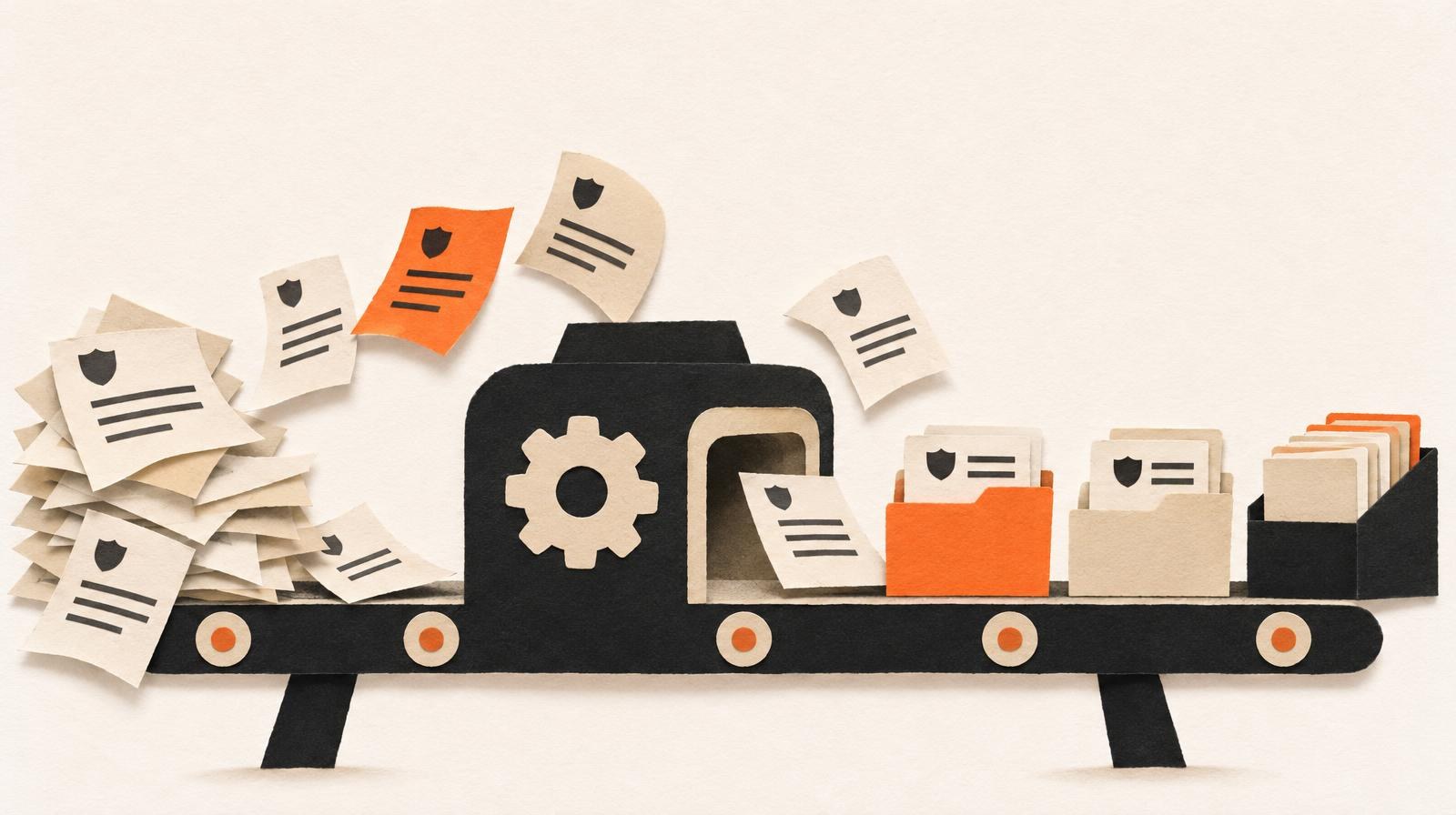
AI audit for insurance agencies: know what to automate, and where to start
What an AI audit looks at in an independent insurance agency, how the 5 days run and what you walk away with. The first call is free, no commitment.
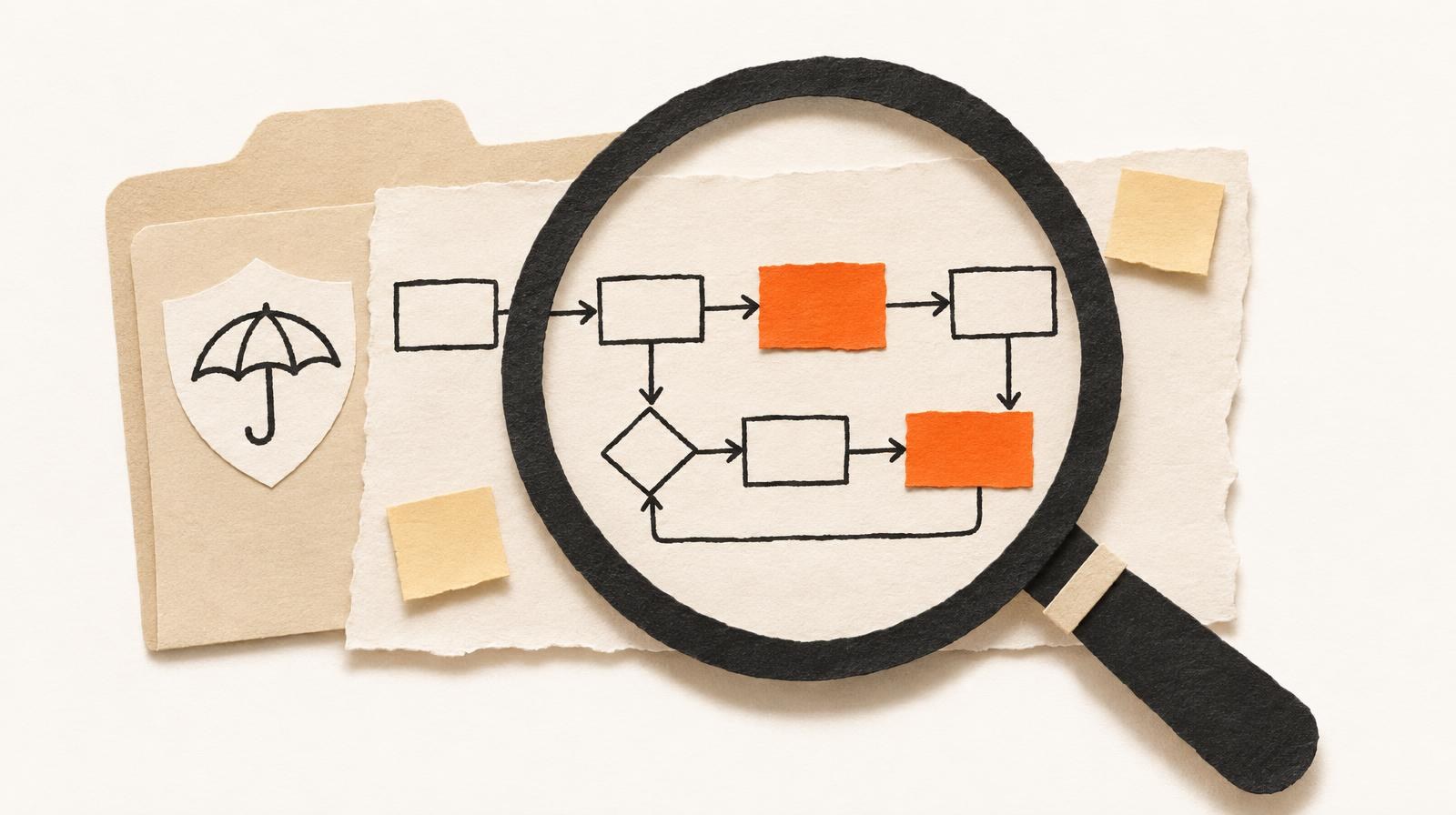
AI may already be at your agency. A CSR uses a chatbot to clean up an email; a producer asks it to summarize a policy. But the days haven’t changed. An AI audit tells you what AI can automate at your insurance agency, what it would cost and where to start. Ours is built for independent agencies. Here’s how it runs, and what you get.
You know AI belongs in your agency. The question is where to start.
Carrier quotes still come in as PDFs, each with its own names for the same coverages, and someone lines them up by hand in a spreadsheet. The same client gets keyed into your comparative rater, then into a carrier portal, then into your agency management system. The signed application never came back, the loss runs are still missing: someone follows up, checks, and follows up again.
This isn’t just an insurance problem. Generative AI is saving U.S. workers some time, but not much yet: 2.2% of their work hours in the second quarter of 2026, by their own estimate, with non-users counted as zero (Bick, Blandin and Deming, Federal Reserve Bank of St. Louis, 2026). Typing an email faster isn’t the same as taking a task off someone’s desk.
So the question isn’t “should we use AI?” anymore. It’s: which task first, what will it cost, and how long will it take? An AI audit answers that, with numbers, before you pick a single tool.
What is an AI audit?
An AI audit is a task-by-task look at how your business runs. We look at how the work gets done today: who does what, with which tools, and how long it takes. Then, for each task, we tell you:
- what AI can automate, partly or fully
- what it would cost
- how long it takes to build
- how quickly it pays for itself
It all ends with a roadmap: your list of projects, ranked from the best return to the lowest.
A lot of AI consulting is about strategy, data and governance, for any kind of business. Ours is about carrier quotes, raters, portals, ACORD forms and loss runs. In other words, we look at what AI can do for insurance agents, and at your agency in particular.
How an AI audit for an insurance agency works, step by step
1. The free call: we pick where to look
We ask about your agency: who does what, with which tools, who’s swamped. You leave with the 2 tasks to automate first, and what each one would save you.
That’s also where we set the scope. We don’t audit the whole agency in one go. We start with the team where the most time goes.
2. Five days with your team
The audit runs for 5 days, remotely.
We interview 2 or 3 people on each team we audit: a CSR, an account manager, whoever handles claims. We watch them work on real accounts, not a demo file. Every task done by hand gets logged: how long it takes, how many times a year, and who does it.
3. The roadmap
At the end of the audit, you get the roadmap, with costs, ranked by return on investment. You know what to do first, and what can wait.
4. Your 2 most urgent automations, built
The audit doesn’t stop at a report. We build your 2 most urgent automations: tasks that take work off your team’s plate without changing how they work. For example, an AI that reads what a client sends in, like a driver’s license or the prior carrier’s dec page, and fills in your system so your CSR doesn’t have to. If the most urgent task turns out to be a big project, we scope and price it separately before we start.
See also: what AI can automate at an insurance agency, task by task.
What an AI audit looks at in an insurance agency
An agency loses time in very specific places. We know them: we’ve built automations like these for insurance brokers in France. Depending on the scope, we go through:
- Client requests: the shared inbox, the questions that keep coming back
- Quoting: carrier quotes to compare, re-keying into your comparative rater and carrier portals, the proposal
- Documents: applications, ACORD forms, loss runs, driver lists; collecting them, checking them, chasing them
- Policy servicing: endorsements, certificates of insurance, renewals, cancellations
- Claims: first notice of loss and follow-up
- Client meetings: call notes and updating the account in your AMS
- Commissions: reconciling carrier commission statements
We also look at your tools: your AMS, your CRM, your raters, carrier portals, spreadsheets. The goal isn’t to replace them. It’s to stop typing the same information in more than one place.
What you get from an AI audit
- A map of your agency: your processes, who handles them, with which tool, and how long they take.
- The roadmap: for each task, what AI can do with it, what it costs, how long it takes to set up and when it pays for itself, ranked from the best return to the lowest.
- The risks and watch-outs, before anything gets built.
- What it can mean for your agency: time back for your team, better margins, more accounts handled without adding headcount.
An example from one of our clients
A group benefits broker compares health and disability quotes from several carriers. Every quote came in as a PDF, each with its own coverage names, and someone retyped it line by line into the comparison spreadsheet.
Now the AI reads each quote, pulls out the coverages and lines them up in one format. A person still checks every quote before it goes to the client.
At a personal lines broker, a bot now fills in each carrier’s rater from the client file. Collecting quotes no longer means typing the same client over and over.
Both are clients in France. You’ll find their measured before-and-after times on our homepage.
What an AI audit doesn’t do
- It doesn’t start with a tool. It starts with where your team’s time goes.
- It doesn’t replace your AMS. AI works next to your tools, from their exports, not instead of them.
- It doesn’t go through the whole agency at once. We start where the most time goes.
- It doesn’t replace anyone. The time saved goes back to your CSRs and account managers: time to advise clients instead of retyping PDFs.
Who an AI audit is for, and who it isn’t
It’s for you if:
- you own or run an independent agency with a team: CSRs, account managers, producers
- your team spends its days on quotes, data entry and follow-ups
- you know AI can help, but not which task to start with
- you want numbers to make the call, not a demo
It’s not for you if:
- you’re a one-person agency: a 5-day audit would be overkill
- your agency doesn’t handle much repetitive work: there won’t be much time to win back
- you want to train your team on ChatGPT first: that’s useful, but it’s a different job
FAQ
How long does an AI audit take?
Ours takes 5 days, done remotely. Your team only gives us the time of a few interviews: 2 or 3 people on each team we audit.
How much does an AI audit cost?
We cover that on the call, once we understand your agency and what the audit needs to cover. You leave with a real number, not a range.
What’s the difference between an AI audit and AI consulting?
AI consulting covers a lot of ground: strategy, training, choosing tools, custom builds. An AI audit is one specific job. We map how your agency works, task by task, and tell you what AI can automate, what it would cost and where to start. Then we build the first two automations.
Do we have to switch agency management systems?
No. We start from the tools you already use: your AMS, your CRM, your raters, carrier portals and spreadsheets. The automations work alongside them or from their exports. Your team keeps working the way it does today.
Do I need to know anything about AI?
No. You know insurance and you know your agency: that’s what the audit needs. AI is our job. We tell you what’s possible, in what order, and we build it.
What about your agency?
A free call, no commitment, to find the 2 tasks to automate first.
Book your free call